



Table of Contents
When I first got curious about AI trading, I didn’t really believe algorithms could outperform human intuition. After experimenting with a few open-source bots, tweaking strategies, and losing a bit of fake money on demo accounts, I realized something important automation isn’t about replacing traders, it’s about removing emotion. In 2025, AI trading isn’t just for Wall Street it’s something any developer or investor can experiment with.
Imagine a trading system that never sleeps, analyzes thousands of data points in milliseconds, and executes trades with precision that no human trader could match. This isn’t science fiction it’s the reality of AI trading algorithms transforming financial markets today.
The trading landscape has fundamentally changed. While traditional traders spent hours analyzing charts and reading market reports, AI-powered trading systems now process news sentiment, technical indicators, macroeconomic data, and social media trends simultaneously making split-second decisions that can mean the difference between profit and loss.
In 2025, AI trading algorithms manage over $1.5 trillion in assets globally, and that number is growing exponentially. From Wall Street hedge funds to retail crypto traders, artificial intelligence has democratized access to sophisticated trading strategies that were once available only to institutional investors.
Whether you’re a seasoned trader looking to automate your strategies or a complete beginner curious about algorithmic trading, this comprehensive guide reveals everything you need to know about AI trading algorithms how they work, their advantages and risks, the best platforms available, and how to get started safely.
What Are AI Trading Algorithms and How Do They Work?
AI trading algorithms are sophisticated computer programs that use artificial intelligence, machine learning, and advanced statistical models to analyze market data and execute trades automatically. Unlike traditional algorithmic trading that follows predetermined rules, AI-driven trading algorithms can learn from historical data, adapt to changing market conditions, and improve their performance over time.
The core components include:
Data Collection and Processing: AI trading systems ingest massive amounts of data from multiple sources price movements, trading volumes, economic indicators, news articles, social media sentiment, and company earnings reports. This data forms the foundation for all trading decisions.
Pattern Recognition: Machine learning models identify complex patterns in historical market data that human traders might miss. These patterns reveal correlations between seemingly unrelated factors, seasonal trends, or subtle market inefficiencies that present trading opportunities.
Predictive Modeling: Using techniques like neural networks, deep learning, and reinforcement learning, AI algorithms forecast future price movements based on identified patterns. These predictions are probability-based assessments that inform trading decisions.
Execution Strategy: Once a trading opportunity is identified, the algorithm determines optimal entry and exit points, position sizing, and risk management parameters. The system then executes trades automatically through broker APIs, often in microseconds.
Continuous Learning: Advanced AI trading systems employ reinforcement learning, where the algorithm continuously evaluates its performance and adjusts strategies based on what works. This adaptive capability separates AI trading from traditional algorithmic approaches.
Key Differences Between AI Trading and Traditional Algorithmic Trading
| Aspect | Traditional Algorithmic Trading | AI Trading Algorithms |
|---|---|---|
| Decision Making | Rule-based (if-then logic) | Adaptive learning from data patterns |
| Flexibility | Fixed rules, manual updates required | Self-adjusting based on market conditions |
| Data Processing | Limited to pre-defined indicators | Processes diverse, unstructured data sources |
| Pattern Recognition | Simple technical patterns | Complex, multi-dimensional relationships |
| Market Adaptation | Requires human intervention | Automatic adaptation to new patterns |
| Learning Curve | Static performance | Improves over time with more data |
Traditional algorithmic trading might execute a simple strategy like “buy when the 50-day moving average crosses above the 200-day moving average.” AI trading algorithms, by contrast, recognize that the moving average crossover works best during specific conditions and continuously refine these parameters based on actual performance.
How Machine Learning Powers AI Trading Strategies
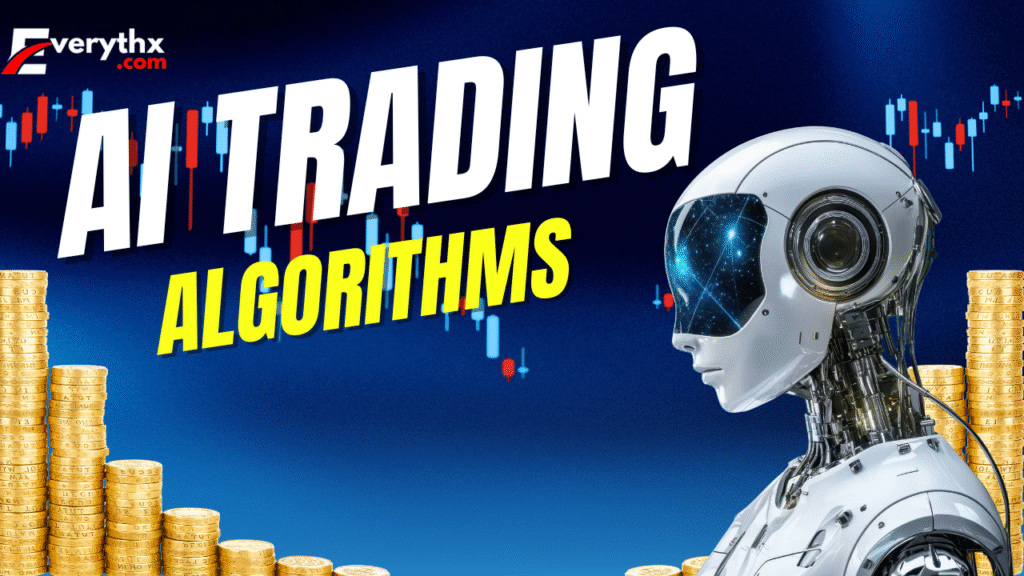
Machine learning integration transforms trading from a reactive process into a predictive science. The three primary approaches used in AI trading each serve distinct purposes:
Supervised Learning trains on historical data where outcomes are known learning which combinations of technical indicators preceded price increases. Popular techniques include Random Forests for classification tasks, Support Vector Machines for finding optimal boundaries, and Neural Networks for capturing non-linear relationships.
Unsupervised Learning discovers hidden patterns without predefined labels. These algorithms identify stocks that move together (clustering) or detect unusual market behavior (anomaly detection). This approach is valuable for portfolio diversification and discovering new trading opportunities.
Reinforcement Learning represents the cutting edge, where algorithms learn optimal strategies through trial and error. The system receives rewards for profitable trades and penalties for losses, gradually learning which actions maximize long-term returns similar to how professional traders develop intuition.
Deep learning neural networks automatically discover the most predictive features from raw data. Long Short-Term Memory (LSTM) networks excel at understanding sequential data like price movements over time, while Natural Language Processing (NLP) powers sentiment analysis that reads and interprets millions of news articles and social media posts.
High-Frequency Trading: AI at Lightning Speed
High-frequency trading (HFT) represents the extreme end of algorithmic trading, where AI systems execute thousands of trades per second. These algorithms exploit tiny price discrepancies that exist for milliseconds, profiting from inefficiencies that human traders couldn’t detect.
How AI algorithms handle high-frequency trading:
- Ultra-Low Latency Infrastructure: Custom chips and servers co-located at exchange data centers where every microsecond matters
- Predictive Market Making: AI predicts short-term order flow and adjusts bid-ask spreads accordingly
- Statistical Arbitrage: Identifying temporary price misalignments between related assets
- Order Execution Optimization: Breaking large orders into smaller pieces to minimize market impact
Modern HFT algorithms include sophisticated risk management that can detect abnormal market conditions and halt trading instantly, preventing contributions to flash crashes like the 2010 event.
Sentiment Analysis: Trading on Market Psychology
Sentiment analysis trading AI quantifies market emotions by analyzing vast amounts of textual and social data to gauge market mood and predict price movements.
Key sentiment data sources:
News Articles: AI scans thousands of financial news sources, identifying whether coverage is positive, negative, or neutral for specific securities.
Social Media: Twitter, Reddit, and StockTwits have become crucial sentiment indicators. AI systems detect unusual activity and coordinate movements before they impact prices.
Earnings Call Transcripts: NLP algorithms analyze not just what executives say, but how they say it. Hesitation, word choice, and tone reveal underlying concerns.
Alternative Data: Satellite imagery of store traffic, credit card transactions, job postings, and weather patterns provide insights before they appear in traditional reports.
Platforms like Sentifi specialize in aggregating these diverse signals into actionable trading indicators. However, sentiment isn’t always predictive effective systems combine sentiment signals with technical and fundamental analysis using machine learning to determine when sentiment is most likely to drive price movements.
Top 20 AI Trading Platforms for 2025
For Stock and Options Traders
1. Trade Ideas (https://trade-ideas.com) AI-powered stock scanner with Holly AI generating real-time trading signals through predictive analytics. Features customizable alerts, backtesting, and probability predictions. Best For: Active day traders | Pricing: $84-$228/month
2. BlackBoxStocks (https://blackboxstocks.com) Real-time AI alerts for unusual options activity and large-block trades with community intelligence. Best For: Options traders | Pricing: $99/month
3. TrendSpider (https://trendspider.com) Automated technical analysis with AI-identified chart patterns and dynamic price alerts. Best For: Technical traders | Pricing: $39-$99/month
For Cryptocurrency Trading
4. Cryptohopper (https://www.cryptohopper.com) Cloud-based crypto trading with pre-built strategies and marketplace for proven algorithms. Best For: Crypto automation | Pricing: Free-$99/month
5. 3Commas (https://3commas.io) Comprehensive AI bots with DCA and grid trading strategies, plus copy trading features. Best For: DCA strategies | Pricing: $22-$75/month
6. Pionex (https://www.pionex.com) 16 built-in AI trading bots completely free with industry-low trading fees. Best For: Beginners | Pricing: Free bots, 0.05% fees
7. WunderTrading (https://wundertrading.com) Multi-exchange AI automation with social trading and strategy copying. Best For: Social trading | Pricing: $19-$99/month
8. Kryll.io (https://kryll.io) Drag-and-drop visual strategy builder with marketplace for renting algorithms. Best For: Visual learners | Pricing: Free-$199/month
9. HaasOnline (https://www.haasonline.com) Institutional-grade automation for complex AI strategies across crypto and stocks. Best For: Advanced traders | Pricing: $9-$49/month
10. TradeSanta (https://tradesanta.com) User-friendly crypto bots with pre-configured templates for quick deployment. Best For: Quick setup | Pricing: $12-$30/month
For Institutional and Advanced Traders
11. AlgoTrader (https://www.algotrader.com) Enterprise-grade platform for hedge funds with multi-asset support and advanced risk management. Best For: Institutions | Pricing: Enterprise
12. QuantConnect (https://www.quantconnect.com) Open-source platform with free cloud backtesting and 250,000+ quant community. Best For: Developers | Pricing: Free-$400/month
13. DataRobot (https://www.datarobot.com) Automated machine learning for building predictive models without extensive data science teams. Best For: Custom models | Pricing: Enterprise
14. C3 AI Suite (https://c3.ai) Production-grade AI applications for trading optimization and risk monitoring. Best For: Large institutions | Pricing: Enterprise
15. Numerai (https://numer.ai) Crowd-sourced hedge fund where data scientists compete to build the best models for cryptocurrency rewards. Best For: Data scientists | Pricing: Free, earn rewards
Specialized Tools
16. Alpaca (https://alpaca.markets) Commission-free trading APIs for developers building custom AI applications. Best For: Custom development | Pricing: Free trading
17. MetaTrader 5 (https://www.metatrader5.com) Popular forex platform with marketplace for 1,000+ AI-powered Expert Advisors. Best For: Forex traders | Pricing: Free platform
18. Sentifi (https://www.sentifi.com) Specialized AI sentiment analysis aggregating social media and news for trading signals. Best For: Sentiment trading | Pricing: Professional subscription
19. Upstox (https://upstox.com) AI-backed automated trading with educational resources, popular in Indian markets. Best For: Retail traders | Pricing: Free account
20. Exxon AI (https://exxonai.com) Predictive analytics focused on risk management using ensemble machine learning. Best For: Risk-focused traders | Pricing: Subscription
How Beginners Can Start Using AI Trading Algorithms
Step 1: Education First – Understand trading fundamentals, risk management, and market structure before deploying any automation. Learn about technical analysis, position sizing, and stop losses.
Step 2: Start with Paper Trading – Every reputable platform offers simulated trading with virtual money. Test strategies for 2-3 months to evaluate performance across different market conditions without risking real capital.
Step 3: Choose Simple Strategies – Begin with proven approaches like grid trading bots, dollar-cost averaging (DCA) bots, or basic trend-following systems. Platforms like Pionex and TradeSanta offer pre-built templates deployable in minutes.
Step 4: Start Small with Real Money – When ready for live trading, use the smallest position sizes possible. The psychological difference between virtual and real money is profound learn with minimal risk.
Step 5: Monitor and Adjust – AI trading isn’t “set and forget.” Monitor bot performance daily, adjust parameters based on market conditions, and stop strategies that consistently lose money.
Common mistakes to avoid: Over-optimization (curve fitting), insufficient capital, ignoring risk management, emotional override of working algorithms, and neglecting trading fees.
Understanding the Risks of AI Trading Bots
Market Risk: AI can’t predict black swan events like the COVID-19 crash. Implement position sizing limits, maximum drawdown thresholds, and circuit breakers for extreme conditions.
Technical Risk: Software bugs, connectivity issues, exchange failures, or API changes can prevent trades from executing. Use cloud-based bots and diversify across exchanges.
Model Risk: Algorithms trained on historical data may fail when market dynamics change. Address through regular retraining, walk-forward analysis, and ensemble approaches combining multiple models.
Execution Risk: Slippage, latency, partial fills, and market impact create differences between signals and actual execution. High-quality platforms with direct exchange connectivity minimize these issues.
Are AI trading bots legal and regulated? Yes, they’re generally legal in the United States and most developed markets, but must comply with securities regulations. The SEC and CFTC regulate algorithmic trading. Individual traders using bots personally typically don’t face registration requirements, but should verify local regulations. Certain strategies like market manipulation remain illegal regardless of automation.
Can AI Trading Algorithms Adapt to Sudden Market Changes?
The answer depends on the AI type. Reinforcement learning systems excel at adaptation, continuously learning from trading results and adjusting when reward patterns change. When markets shift from trending to ranging, these agents recognize the change and modify their approach.
Traditional machine learning models with fixed weights struggle until retrained. However, modern systems address this through:
- Ensemble Methods: Combining models trained on different conditions
- Online Learning: Continuous retraining on new data
- Regime Detection: Meta-layers identifying current market conditions
- Dynamic Parameters: Adjusting settings based on recent volatility
The COVID-19 crash demonstrated that algorithms incorporating risk management, volatility awareness, and ability to recognize extreme conditions performed best.
How Accurate Are AI Trading Algorithms?
Professional quantitative trading firms typically achieve directional accuracy rates of 50-55%. This doesn’t sound impressive until you understand that profitability doesn’t require high win rates it requires favorable risk-reward ratios.
What different accuracy levels mean:
- 50-52%: Realistic baseline for retail AI systems
- 53-58%: Professional-grade systems in predictable market segments
- 60%+: Extremely rare, limited to specific conditions
- 70%+: Almost always reflects curve-fitting or fraud
Markets are influenced by countless unknowable variables. Perfect prediction is impossible. The Efficient Market Hypothesis suggests publicly available information is already reflected in prices, making consistent prediction extremely difficult.
Evaluate AI performance through:
- Out-of-sample results on unseen data
- Walk-forward analysis on future periods
- Performance across multiple market conditions
- Risk-adjusted returns (Sharpe ratio, maximum drawdown)
- Results after transaction costs
- Sufficient sample size (100+ trades minimum)
The Future of AI Trading: 2025 Trends
Generative AI Integration: Large language models analyzing earnings calls, generating strategy hypotheses, and explaining AI decisions in plain English.
Quantum Computing: Portfolio optimization with exponentially more combinations, complex option pricing, and pattern recognition in high-dimensional data.
Decentralized AI Trading: Smart contracts executing AI-based trades, decentralized autonomous funds, and tokenized AI strategies on blockchain.
Explainable AI Requirements: Regulators demanding clear explanations for AI decisions, audit trails, and bias testing.
Alternative Data Explosion: Satellite imagery, credit card transactions, weather patterns, and web scraping integrated into predictive models.
Multi-Agent Systems: Multiple specialist AI agents working cooperatively and competitively, coordinated by meta-agents.
Frequently Asked Questions
Can beginners use AI trading bots?
Yes, beginners can start with user-friendly platforms like Pionex, TradeSanta, or Cryptohopper that offer pre-built bot templates. Start with paper trading for 2-3 months, learn risk management fundamentals, and begin with small position sizes when transitioning to live
How accurate are AI trading algorithms?
Most AI trading algorithms achieve 50-55% directional accuracy, with professional systems reaching 60% under optimal conditions. Profitability depends on risk-reward ratios, not just win rates. Claims of 70%+ accuracy are typically unrealistic and should be viewed skeptically.
Are AI trading bots legal in the USA?
Yes, AI trading bots are legal in the United States for personal use. They must comply with SEC and CFTC regulations, but individual traders using bots for their own accounts typically don’t need special registration. However, market manipulation strategies remain illegal regardless of automation.
What are AI trading algorithms?
AI trading algorithms are computer programs that use machine learning and artificial intelligence to analyze market data and execute trades automatically. They learn from historical patterns, adapt to changing conditions, and make trading decisions faster than humans processing thousands of data points in milliseconds.
Conclusion: Your Path Forward
AI trading isn’t about building one perfect bot it’s about learning from the feedback loop. Every trade, every dataset, every mistake makes your algorithm smarter. As developers, we’re in a unique position to merge code with finance and the earlier we start experimenting, the faster we’ll adapt to this new era of automated trading.
Key takeaways:
- AI isn’t magic – Success requires understanding both markets and technology
- Start small – Begin with paper trading, use simple strategies, gradually progress
- Risk management is paramount – Protect capital through proper position sizing and diversification
- Choose the right tools – Match platforms to your needs and experience level
- Maintain realistic expectations – Consistent modest returns beat spectacular unsustainable results
Whether you’re seeking real-time signals, 24/7 crypto automation, or building custom systems, AI trading algorithms provide powerful tools to enhance your edge. The question isn’t whether AI will transform your trading it’s how you’ll adapt to thrive in this new paradigm.
The algorithms are ready. The platforms are accessible. Your journey begins with education, continues with careful experimentation, and succeeds through disciplined execution and continuous improvement.
Ready to start? Choose a platform from our top 20 recommendations, begin paper trading to test strategies risk-free, and join the growing community of traders leveraging AI for smarter, more profitable trading.

How Much I Really Charge for Websites ($500-$2,000 Breakdown)